Redistricting Cases: How Legal Challenges Altered the Battlefield
Advertisements
Redistricting legal challenges have played an important role in defining how electoral districts are drawn and reviewed across the United States.
Six landmark Supreme Court cases discussed in the source address racial discrimination, population equality, minority voting rights, and the limits of federal judicial review over partisan gerrymandering.
Together, these decisions provide historical and legal context for understanding how district boundaries can affect representation across the 435 seats of the U.S. House of Representatives.
Understanding the Battlefield: Redistricting Basics and Legal Scrutiny
The decennial census triggers a new round of congressional and legislative redistricting as states adjust district boundaries to account for population changes.
Redistricting legal challenges can arise when maps are alleged to violate constitutional protections, minority voting rights, or requirements concerning population equality.
The resulting court decisions establish rules that influence how states approach future maps and how disputes over representation are resolved.
Gerrymandering and the Supreme Court: A Shifting Legal Landscape
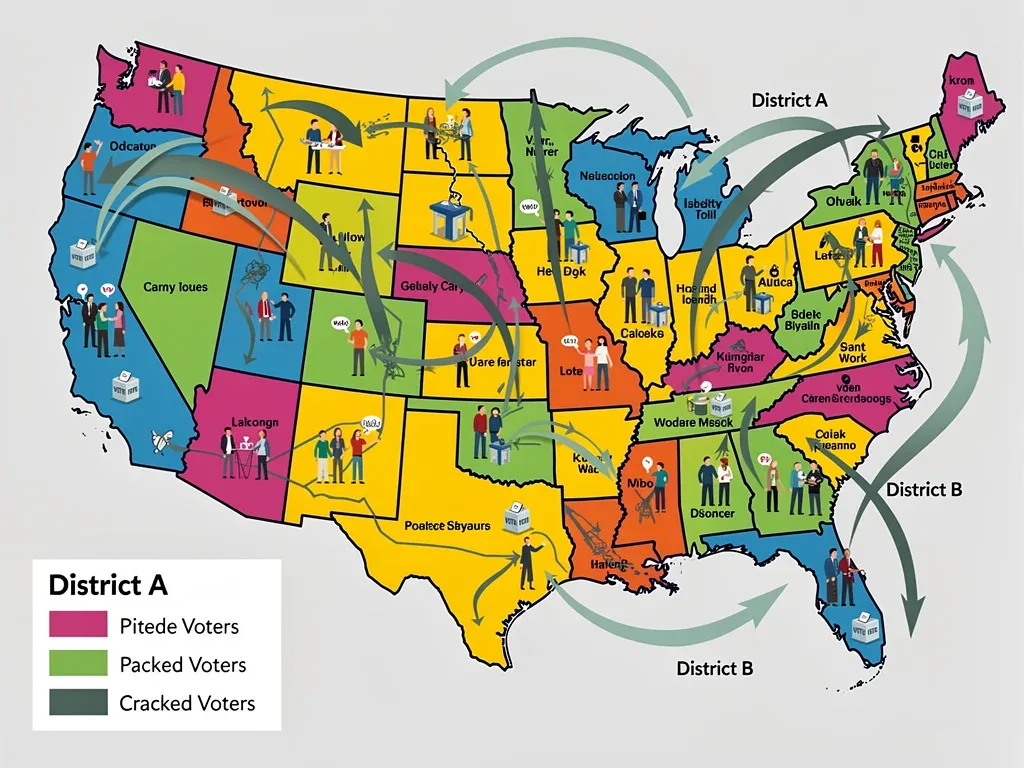
Gerrymandering generally refers to drawing electoral districts in ways that advantage a political group or otherwise influence electoral outcomes.
The Supreme Court has recognized judicially enforceable constitutional limits in areas including racial discrimination and population inequality, while treating partisan-gerrymandering claims differently under federal law.
This distinction forms an important part of the legal framework surrounding modern redistricting legal challenges.
Landmark Case 1: Gomillion v. Lightfoot (1960)
In Gomillion v. Lightfoot, the Supreme Court considered the redrawing of Tuskegee, Alabama's municipal boundaries in a way that excluded nearly all Black residents while retaining white residents.
The Court held that the challenged boundary change could violate the Fifteenth Amendment when state action effectively impaired voting rights on racial grounds.
The case became an important early precedent demonstrating that governmental control over district or municipal boundaries was still subject to constitutional limits.
Landmark Case 2: Baker v. Carr (1962)
Baker v. Carr significantly changed federal judicial involvement in legislative apportionment disputes.
The Supreme Court held that an Equal Protection challenge to legislative apportionment was justiciable rather than automatically barred as a political question.
This decision opened the way for later cases addressing population equality in congressional and state legislative districts.
The ruling established that unequal electoral districts could raise constitutional claims.
It enabled federal courts to hear certain redistricting disputes.
The decision laid groundwork for later population-equality rulings.
The "One Person, One Vote" Principle: Reynolds v. Sims and Wesberry v. Sanders
Following Baker v. Carr, later Supreme Court decisions established stronger population-equality requirements for legislative districts.
These rulings required states to address substantial population disparities that had allowed voters in differently populated districts to have unequal representational weight.
The principle became a major component of subsequent redistricting legal challenges involving congressional and state legislative maps.
Landmark Case 3: Reynolds v. Sims (1964)
Reynolds v. Sims applied population-equality principles to state legislative districts.
The decision required both houses of state legislatures to be apportioned substantially according to population rather than maintaining highly unequal districts.
The ruling contributed to widespread changes in state legislative maps and strengthened the constitutional principle of equal representation.
Landmark Case 4: Wesberry v. Sanders (1964)
Wesberry v. Sanders addressed population disparities among congressional districts within a state.
The Supreme Court required congressional districts to be drawn as nearly equal in population as practicable, helping establish population equality as a central congressional-redistricting standard.
This requirement directly affected how states structured districts within the national 435-seat battlefield.
Both cases reinforced population equality in electoral districts.
They required significant redistricting changes in many states.
The rulings reduced representation disparities created by heavily unequal district populations.
Voting Rights Act and Redistricting: Thornburg v. Gingles
The Voting Rights Act of 1965 became a central federal statute in disputes involving racial discrimination and minority voting strength.
Section 2 has been used in challenges alleging that electoral arrangements improperly dilute the ability of protected minority groups to participate effectively in the political process.
This framework has therefore become an important component of racial-vote-dilution redistricting legal challenges.
Landmark Case 5: Thornburg v. Gingles (1986)
Thornburg v. Gingles interpreted Section 2 of the Voting Rights Act in a dispute involving minority vote dilution.
The case established threshold considerations commonly called the Gingles preconditions, addressing population size and compactness, political cohesion, and majority bloc voting.
This framework became influential in later litigation involving whether electoral arrangements improperly prevented minority voters from electing candidates of their choice.
Partisan Gerrymandering: Rucho v. Common Cause and its Aftermath
Federal treatment of partisan gerrymandering developed differently from cases involving racial discrimination or population inequality.
The Supreme Court acknowledged concerns surrounding highly partisan districting but concluded in 2019 that partisan-gerrymandering claims present political questions beyond the reach of federal courts.
This decision shifted greater attention toward state law, state courts, legislation, and political reform as mechanisms for addressing partisan districting.
Landmark Case 6: Rucho v. Common Cause (2019)
In Rucho v. Common Cause, the Supreme Court considered challenges alleging excessive partisan manipulation of electoral districts.
The Court concluded that partisan-gerrymandering claims present political questions beyond the jurisdiction of federal courts because no judicially manageable federal constitutional standard had been identified.
The decision did not prevent challenges based on other legal grounds, but it substantially limited federal-court litigation based solely on excessive partisan gerrymandering.
The Enduring Impact on the National 435-Seat Battlefield
The six cases discussed in the source collectively helped define constitutional and statutory rules governing electoral boundaries.
They address different legal questions, ranging from racial discrimination and population equality to minority vote dilution and the justiciability of partisan-gerrymandering claims.
The resulting framework continues to affect how maps within the national 435-seat battlefield are drawn, challenged, and reviewed.
State-Level Litigation and Future Prospects
After Rucho v. Common Cause, state constitutions and state courts became especially important avenues for some partisan-gerrymandering disputes.
The Supreme Court itself noted that its federal ruling did not eliminate every mechanism for addressing partisan districting, pointing to state constitutional provisions and legislative action among available alternatives.
This means future redistricting legal challenges can produce different outcomes depending on the legal standards applicable in individual states.
State courts can be important venues for partisan-gerrymandering challenges based on state law.
Advocates may rely on state constitutional provisions and state-specific standards.
Different state legal frameworks can lead to different redistricting outcomes.
The Role of Independent Redistricting Commissions
Some states have created independent or bipartisan commissions as alternatives to having legislatures exercise primary control over redistricting.
These systems are intended to modify the institutional incentives surrounding map drawing and may apply criteria established by state law or constitutional provisions.
Their existence adds another dimension to how districts within the national 435-seat battlefield are created.
Challenges to Commission-Drawn Maps
Maps produced by commissions can still face litigation alleging violations of constitutional, statutory, or state-law requirements.
Legal disputes may concern compliance with voting-rights rules, population requirements, procedural mandates, or the standards governing the commission itself.
Commission-based systems therefore do not eliminate redistricting legal challenges, but they change the institutional setting in which maps are initially developed.
Key Case | Impact on Redistricting |
|---|---|
Gomillion v. Lightfoot | Addressed racially discriminatory boundary changes under the Fifteenth Amendment. |
Baker v. Carr | Enabled federal courts to review certain legislative-apportionment claims. |
Reynolds v. Sims | Applied population-equality principles to state legislative districts. |
Rucho v. Common Cause | Held federal partisan-gerrymandering claims to be nonjusticiable political questions. |
Frequently Asked Questions About Redistricting Legal Challenges
What is the primary goal of redistricting legal challenges?▼
Such cases generally seek judicial review of electoral maps alleged to violate constitutional, statutory, or state-law requirements governing representation and districting.
How does "one person, one vote" affect redistricting?▼
Population-equality principles require districts to meet applicable standards designed to prevent substantial inequalities in representational weight.
Can federal courts still address partisan gerrymandering?▼
Under Rucho v. Common Cause, claims alleging excessive partisan gerrymandering by itself are treated as political questions beyond federal judicial review, although other legal claims and state-law challenges may remain available.
What role does the Voting Rights Act play in redistricting?▼
The Voting Rights Act provides federal protections against voting practices that unlawfully discriminate or dilute protected minority voting strength.
Why are independent redistricting commissions used?▼
They provide an alternative institutional structure for drawing districts instead of leaving the process entirely under ordinary legislative control.
Looking Ahead: The Evolving Landscape of Electoral Maps
Redistricting legal challenges will continue to operate within a framework shaped by federal constitutional rules, the Voting Rights Act, state constitutions, and state-specific redistricting systems.
The six cases discussed in the source illustrate how judicial doctrine has evolved differently across racial discrimination, population equality, minority vote dilution, and partisan-gerrymandering disputes.
Understanding these decisions provides historical context for how legal rules continue to influence the drawing and review of districts within the national 435-seat battlefield.