2026 War Powers Resolution Amendments: Limiting Presidential Action?
Advertisements
Latest developments on Can 2026 War Powers Reform Limit Unilateral Presidential Military Actions? center on renewed congressional efforts to strengthen the procedures lawmakers can use when challenging military operations that lack specific statutory authorization.
One concrete proposal is H.R. 8435, the War Powers Priority Procedures Modernization Act, introduced in the House on April 22, 2026. The bill would modify procedural provisions of the existing War Powers Resolution rather than replace its entire framework.
The broader debate remains focused on the constitutional balance between Congress's war powers and the President's authority as Commander-in-Chief, particularly when military operations begin without a formal declaration of war.
Understanding the War Powers Resolution of 1973
The War Powers Resolution was enacted in 1973 to promote the collective participation of Congress and the President when U.S. Armed Forces are introduced into hostilities or situations where involvement in hostilities is imminent.
Under section 5(b), the President generally must terminate covered military involvement within 60 calendar days unless Congress declares war, provides specific authorization, extends the period, or is unable to meet because of an armed attack on the United States.
An additional period of up to 30 days can apply when the President certifies that unavoidable military necessity related to the safe withdrawal of U.S. forces requires additional time.
What the 2026 War Powers Proposal Actually Changes
The principal legislative reform proposal identified in 2026 is H.R. 8435, the War Powers Priority Procedures Modernization Act, introduced by Representatives Tom Barrett and Jared Golden.
The bill would amend section 5(c) of the War Powers Resolution so that its removal mechanism expressly covers a “joint resolution” in addition to a concurrent resolution. It would also extend priority procedures to qualifying joint resolutions.
Importantly, the introduced bill does not shorten the existing 60-day period, establish a new definition of “imminent threat,” or broadly rewrite the statutory definition of hostilities.
Priority Procedures for Joint Resolutions
H.R. 8435 would modify the congressional procedures that apply when lawmakers seek removal of U.S. forces engaged in unauthorized hostilities outside U.S. territory.
Its text adds joint resolutions to procedural provisions that currently refer to concurrent resolutions and seeks to ensure that qualifying measures receive priority consideration in Congress.
This distinction matters because a joint resolution passed by both chambers can be presented to the President, unlike a concurrent resolution, although a presidential veto can still create an additional congressional hurdle.
What Happens After a Presidential Veto?
The legislation specifically addresses the possibility that a President could veto a joint resolution directing the removal of U.S. forces from unauthorized hostilities.
Under the proposed language, debate on the veto message would be limited to 20 hours in the Senate and 20 hours in the House, creating an expedited path for lawmakers to consider an override.
The proposal would therefore change congressional procedure rather than automatically terminate a military operation or eliminate the President's ability to veto a removal measure.
Historical Context: Presidential and Congressional Authority
The Constitution divides responsibilities related to military force between Congress and the executive branch, creating a recurring institutional dispute over where one branch's authority ends and the other's begins.
The War Powers Resolution was designed to reinforce a framework in which both branches participate when U.S. forces enter hostilities, while preserving the President's ability to respond to certain emergencies.
Disagreements have nevertheless continued across administrations over what constitutes “hostilities,” when the statutory clock begins, and how congressional restrictions interact with presidential powers under Article II.
The Iran Conflict Has Put War Powers Back at the Center of Congress
The debate has become particularly significant in 2026 because Congress has repeatedly considered resolutions involving U.S. military operations against Iran.
On September 15, 2026, the House voted 220–204 to approve H. Con. Res. 93, directing the President under section 5(c) of the War Powers Resolution to remove U.S. forces from hostilities with Iran.
That vote followed earlier House action on similar Iran resolutions, illustrating how the existing War Powers Resolution continues to be used independently of the proposed H.R. 8435 procedural changes.

Could the 2026 Proposal Actually Limit Unilateral Military Action?
H.R. 8435 could make it procedurally easier for Congress to force consideration of legislation seeking the removal of U.S. forces, but its practical effect would depend on congressional votes and the President's response.
Because a joint resolution presented to the President may be vetoed, Congress could still need the constitutionally required two-thirds majority in each chamber to override that veto.
The proposal therefore strengthens the congressional process available for challenging unauthorized military action, but it would not give Congress an automatic mechanism for ending every operation initiated by a President.
Potential Impact on U.S. Foreign Policy and Alliances
Changes to congressional war-powers procedures could affect how administrations plan military operations when explicit statutory authorization has not already been granted.
Foreign governments could also pay closer attention to congressional positions when evaluating whether a U.S. military commitment is likely to continue over an extended period.
The practical effect would vary by conflict because some operations are supported by specific congressional authorizations while others rest more heavily on asserted executive authority.
Constitutional Questions and Legal Scrutiny
Any attempt to strengthen congressional control over military deployments operates within a longstanding constitutional disagreement about the respective powers of Congress and the President.
The War Powers Resolution itself states that its purpose is to ensure that the collective judgment of both branches applies to decisions involving U.S. forces in hostilities.
At the same time, administrations have historically asserted independent Article II authority in certain circumstances, meaning disputes can arise over whether particular operations require additional congressional authorization.
Why the Form of the Resolution Matters
The distinction between concurrent and joint resolutions is central to H.R. 8435 because the legislative consequences of the two instruments are different.
A joint resolution normally follows the legislative process and is presented to the President, while a concurrent resolution is generally not presented for presidential signature and does not become law.
H.R. 8435 explicitly adds joint resolutions to section 5(c) and to the priority procedures governing efforts to require the removal of forces from unauthorized hostilities.
Congressional Debate and Political Divisions
War-powers votes in 2026 have crossed party lines in some instances, even though lawmakers continue to disagree over the proper congressional response to ongoing military operations.
The September 15 House vote on Iran passed 220–204, with all House Democrats voting in favor along with seven Republicans, according to reporting on the vote and official House records.
Supporters of withdrawal measures emphasize congressional authorization, while opponents have argued that restricting current operations could undermine the executive branch's ability to respond to security threats.
Why Congressional Procedure Is Central to the Debate
A central problem in war-powers disputes is not simply whether members of Congress oppose an operation, but whether they can bring a binding measure through both chambers and complete the legislative process.
H.R. 8435 attempts to address that institutional issue by extending priority procedures to joint resolutions and setting limits on debate when a President vetoes such a measure.
Supporters may view these procedures as a way to make Congress's constitutional role more operational, while opponents may question whether expedited mechanisms could reduce executive flexibility during military crises.
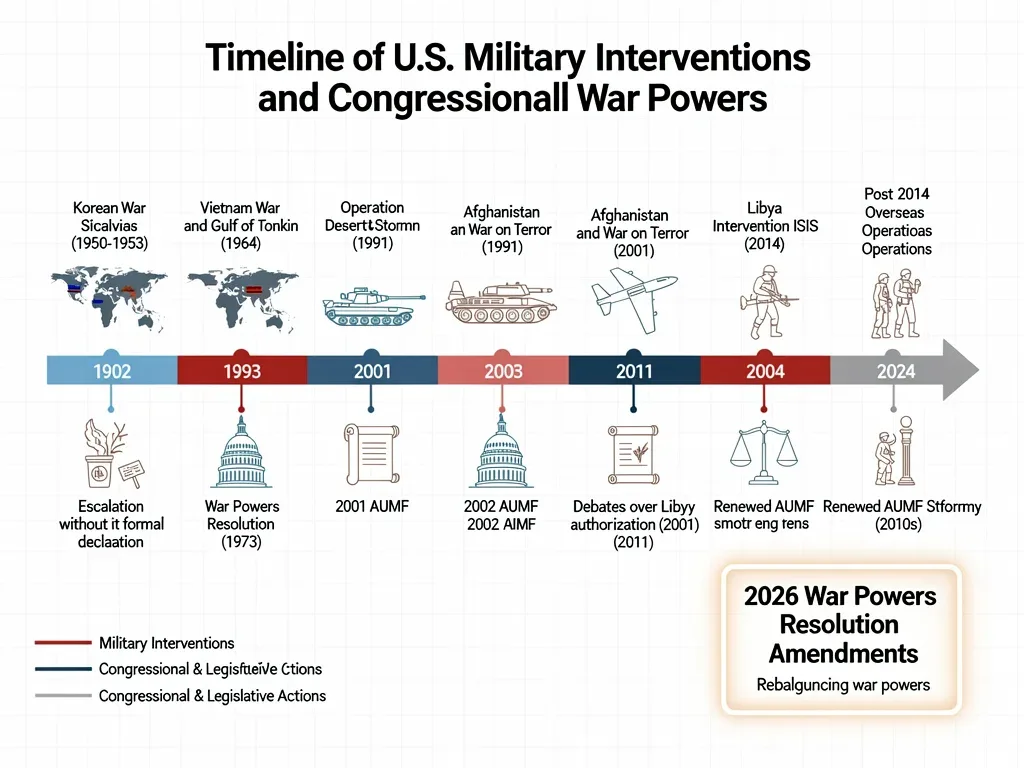
Separate War Powers Measures in 2026
H.R. 8435 is not the only war-powers legislation considered during 2026, and it should not be confused with conflict-specific resolutions addressing U.S. operations against Iran.
For example, H.J. Res. 156 was introduced in April 2026 to direct compliance with the existing 60-day use-of-force limit and the potential additional 30-day withdrawal period in connection with U.S. operations in Iran.
Other House measures have directly instructed the President to remove U.S. forces from hostilities with Iran under section 5(c), demonstrating different ways lawmakers can use the War Powers framework.
Future Implications for Executive-Legislative Relations
If H.R. 8435 were enacted, Congress would gain additional procedural tools for considering joint resolutions intended to terminate unauthorized military involvement.
The ultimate effect would still depend on whether majorities in both chambers support a measure and, if the President vetoes it, whether Congress can assemble the votes required for an override.
For that reason, the proposal could alter how war-powers disputes move through Congress without resolving the larger constitutional disagreement between executive and legislative authority.
Key Point | Brief Description |
|---|---|
H.R. 8435 | The 2026 War Powers Priority Procedures Modernization Act would expand priority procedures to qualifying joint resolutions. |
60-Day Rule | The existing War Powers Resolution generally provides a 60-day period, with a possible additional 30 days for withdrawal under specified conditions. |
Presidential Veto | H.R. 8435 would limit debate on the veto message for a qualifying joint resolution to 20 hours in each chamber. |
Iran Resolutions | The House has separately approved resolutions in 2026 seeking removal of U.S. forces from hostilities with Iran. |
Frequently Asked Questions About 2026 War Powers Reform
Is there a law called the “2026 War Powers Resolution Amendments”?▼
Not as a broad enacted package matching that description. One specific reform proposal is H.R. 8435, the War Powers Priority Procedures Modernization Act, introduced on April 22, 2026. As of the cited congressional record, it was introduced and referred to the House Foreign Affairs and Rules Committees.
Does H.R. 8435 shorten the 60-day War Powers deadline?▼
No. The introduced text does not shorten the existing 60-day period. Its changes concern congressional procedures for concurrent and joint resolutions and consideration of a presidential veto.
Could H.R. 8435 prevent a President from using military force without Congress?▼
It would not create an absolute prohibition on unilateral military action. It would change procedures available to Congress when seeking removal of forces engaged in hostilities without a declaration of war or specific statutory authorization.
Why are joint resolutions important?▼
A joint resolution passed by both chambers can be presented to the President and can become law. H.R. 8435 would expressly incorporate joint resolutions into additional War Powers priority procedures, including procedures following a presidential veto.
What happened with war powers in Congress in September 2026?▼
On September 15, 2026, the House approved H. Con. Res. 93 by a vote of 220–204, directing the President to remove U.S. forces from hostilities with Iran under section 5(c) of the War Powers Resolution.
What This Means
The most significant 2026 reform proposal identified here is narrower than the original article suggested: H.R. 8435 primarily addresses how Congress processes resolutions intended to end unauthorized military involvement.
At the same time, repeated congressional votes involving Iran show that the broader dispute over presidential and congressional war powers remains active rather than theoretical.
What matters next is whether H.R. 8435 advances beyond committee, whether additional reform legislation emerges, and how Congress and the executive branch respond to current War Powers resolutions involving U.S. military operations.