National Debt in 2026: Economic Implications & Policy Responses

Advertisements
Latest developments on the National Debt show the United States facing historically large deficits, with CBO projecting a $1.9 trillion federal deficit in fiscal year 2026 and continued growth through 2036. Treasury data also shows total public debt is updated daily, making debt levels, borrowing costs, and interest payments central issues for policymakers and investors.
The economic concern is that higher debt can increase federal interest costs, pressure future budgets, and limit flexibility for priorities such as Social Security, Medicare, defense, and infrastructure. CBO projects deficits will remain above their 50-year average as a share of GDP, while debt held by the public continues rising over the next decade.
Readers should monitor Treasury yields, federal budget negotiations, tax policy proposals, spending reforms, and future CBO updates throughout 2026. The key question is whether lawmakers can slow debt growth without weakening economic stability, household confidence, or long-term public investment.
The Current State of the National Debt and its Trajectory
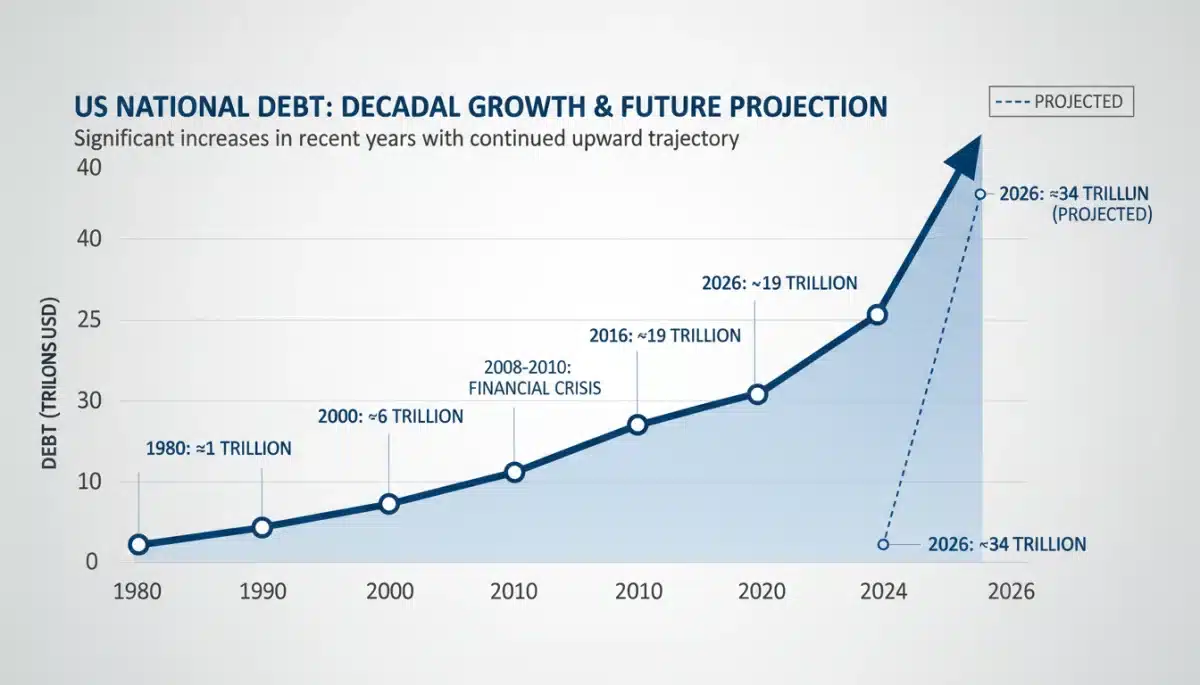
The United States national debt continues its upward climb, reaching unprecedented levels. Projections for 2026 indicate a further escalation, driven by persistent budget deficits and increasing federal expenditures.
This growth is not merely a statistical anomaly; it reflects a complex interplay of fiscal policy, economic cycles, and unforeseen global events. Understanding the current trajectory is crucial for grasping future implications.
Official reports from bodies like the Congressional Budget Office (CBO) consistently forecast a challenging fiscal outlook. These analyses form the bedrock for discussions on National Debt, providing critical data for informed decision-making.
Factors Contributing to Debt Growth
- Persistent Budget Deficits: The federal government has consistently spent more than it collects in revenue, leading to annual deficits that add to the national debt. This structural imbalance is a primary driver.
- Increased Federal Spending: Significant outlays for social programs, defense, and recent stimulus packages have expanded government expenditures. These commitments contribute substantially to the debt’s acceleration.
- Slowed Revenue Growth: While the economy has grown, revenue collection has not always kept pace with spending increases. Economic slowdowns or tax cuts can further exacerbate this disparity.
The accumulation of debt is a multi-faceted problem, reflecting decades of fiscal decisions and reactions to economic crises. Each factor, from tax policy to social welfare programs, plays a role in shaping National Debt.
The long-term implications of these contributing factors are profound, affecting future generations and the nation’s economic flexibility.
Addressing the root causes requires a concerted effort and a clear understanding of the fiscal landscape.
Economic Implications for the United States in 2026
The burgeoning national debt carries significant economic implications for the United States as we approach 2026. These effects extend across various sectors, influencing everything from interest rates to investment opportunities.
A higher national debt can lead to increased borrowing costs for the government, potentially crowding out private investment. This phenomenon, known as ‘crowding out,’ can stifle economic growth and innovation.
Furthermore, the debt’s magnitude can impact the dollar’s international standing and the nation’s fiscal credibility. These are critical considerations when evaluating National Debt.
Impact on Interest Rates and Inflation
A growing national debt often necessitates increased government borrowing, which can drive up demand for credit and, consequently, interest rates. Higher interest rates affect consumers and businesses alike, making loans more expensive.
There is also a concern that persistent large deficits could lead to inflationary pressures if the Federal Reserve is compelled to monetize the debt. This could erode purchasing power and destabilize the economy.
The interplay between debt, interest rates, and inflation is a delicate balance, and any significant shift could have far-reaching consequences. This makes managing National Debt a top priority.
The burden of servicing the debt also grows with rising interest rates, diverting a larger portion of the federal budget away from other critical investments. This trade-off can hinder long-term economic development.
Moreover, the perception of fiscal instability due to high debt levels can deter foreign investment, further impacting economic vitality. Addressing these implications is central to discussions on National Debt.
Potential Impacts on Future Generations and Public Services
The escalating national debt poses a substantial burden on future generations, who will inherit the responsibility of servicing this debt. This intergenerational transfer of obligation raises ethical and economic concerns.
A larger portion of future tax revenues may be allocated to interest payments, potentially reducing funds available for essential public services and investments. Education, infrastructure, and research could all face funding constraints.
This long-term outlook is a critical component of understanding National Debt. It underscores the need for sustainable fiscal planning.
Strain on Social Security and Medicare
Entitlement programs like Social Security and Medicare represent a significant portion of federal spending. The aging population and rising healthcare costs place increasing pressure on these programs, further contributing to the national debt.
Without significant reforms, the financial solvency of these programs is threatened, potentially leading to reduced benefits or increased taxes for future retirees. This adds another layer of complexity to the debt discussion.
The long-term fiscal health of these crucial safety nets is intrinsically linked to the broader issue of National Debt. Solutions must consider both current needs and future sustainability.
The implications for public services extend beyond entitlements, affecting the government’s capacity to respond to future crises or invest in growth-enhancing projects. A high debt limits fiscal maneuverability, making it harder to implement counter-cyclical policies during economic downturns.
Therefore, any comprehensive strategy for managing the debt must address these foundational issues. The conversation around National Debt is fundamentally about securing a stable economic future for all Americans.
Policy Responses and Proposed Solutions
Addressing the national debt requires a multifaceted approach involving various policy responses. These solutions often involve a combination of spending cuts, revenue increases, and economic growth strategies.
Policymakers face the challenging task of balancing immediate economic needs with long-term fiscal sustainability. The political will and bipartisan cooperation are crucial for implementing effective measures.
The debate over the optimal policy mix for managing National Debt is ongoing, with various proposals emerging from different political and economic perspectives.
Strategies for Fiscal Consolidation
- Spending Reductions: This involves cutting back on federal expenditures across various departments and programs. Options range from minor trims to significant overhauls of entitlement programs or defense spending.
- Revenue Enhancements: Increasing government revenue can be achieved through various tax adjustments, such as raising income tax rates, implementing new taxes, or closing tax loopholes. The goal is to broaden the tax base or increase collection efficiency.
- Economic Growth Initiatives: Policies aimed at boosting economic growth, such as investments in infrastructure, education, and innovation, can indirectly help reduce the debt-to-GDP ratio. A larger economy generates more tax revenue.
Each of these strategies comes with its own set of challenges and political considerations. Finding common ground on how to implement them is a major hurdle in tackling National Debt effectively.
Successful fiscal consolidation often requires a combination of these approaches, tailored to the specific economic environment. The timing and scale of implementation are also critical factors for their effectiveness.
The Role of Monetary Policy and the Federal Reserve
Monetary policy, primarily managed by the Federal Reserve, plays a significant but indirect role in the context of the national debt. While fiscal policy directly addresses spending and taxation, monetary policy influences the economic environment in which debt operates.
The Federal Reserve’s decisions on interest rates and its balance sheet operations can impact the cost of government borrowing. Lower interest rates can reduce the government’s debt servicing costs, but they also carry risks.
Understanding this intricate relationship is essential for a comprehensive view of National Debt. The Fed’s actions can either alleviate or exacerbate fiscal pressures.
Navigating Inflation and Economic Growth
The Federal Reserve’s dual mandate is to maintain maximum employment and stable prices. These objectives can sometimes be at odds with the fiscal challenges posed by a high national debt.
If inflation rises, the Fed may increase interest rates, thereby increasing the cost of servicing the national debt. Conversely, keeping rates low to stimulate growth might fuel inflation, creating a dilemma.
The Fed’s independence from political pressures is crucial in making these difficult decisions, which directly or indirectly influence National Debt.

The size of the Fed’s balance sheet, particularly its holdings of government bonds, also impacts market liquidity and interest rates. Any unwinding of these holdings must be carefully managed to avoid market disruption.
Ultimately, while the Fed cannot directly solve the national debt problem, its actions create the economic backdrop against which fiscal policies are enacted.
Collaboration and clear communication between fiscal and monetary authorities are paramount.
International Perspectives and Global Economic Standing
The national debt in 2026 is not solely a domestic issue; it has significant international ramifications. The United States’ fiscal health impacts its global economic standing and geopolitical influence.
A high and rising national debt can erode investor confidence in U.S. government bonds, potentially leading to higher borrowing costs in international markets. This can affect the dollar’s role as the world’s primary reserve currency.
Global financial markets closely monitor U.S. fiscal policy, and any perceived instability could trigger capital outflows or currency depreciation. This highlights the interconnectedness of National Debt with global finance.
Geopolitical Implications of Fiscal Health
The ability of the U.S. to project power and maintain its leadership role is partly underpinned by its economic strength and fiscal stability. A weakened fiscal position could limit its capacity to respond to international crises or fund foreign policy initiatives.
Other nations, particularly economic rivals, may leverage concerns about U.S. debt to challenge its global influence. This adds a strategic dimension to the domestic fiscal debate.
Therefore, managing National Debt is not just about domestic economics, but also about maintaining America’s standing on the world stage.
The U.S. debt also affects global interest rates and financial stability, given the sheer size of its economy and financial markets. A crisis of confidence in U.S. debt could send shockwaves through the international financial system.
Maintaining fiscal discipline is thus crucial for both domestic prosperity and international leadership. The discussions surrounding National Debt reflect these complex interdependencies.
Navigating Political Divides for Fiscal Responsibility
Addressing the national debt requires overcoming significant political divides. Different political ideologies often lead to conflicting views on spending priorities, tax policies, and the role of government.
Bipartisan cooperation is essential but often elusive in the highly polarized political landscape. Without a unified approach, effective long-term solutions remain difficult to implement.
The challenge of navigating these political obstacles is a central theme in discussions about National Debt. It underscores the need for compromise and shared commitment.
Building Consensus for Sustainable Policies
Achieving fiscal responsibility demands difficult choices that may be unpopular with certain constituencies. These include potential cuts to popular programs or increases in taxes, which politicians are often reluctant to endorse.
Public education and engagement are vital to building support for necessary reforms. Citizens need to understand the long-term consequences of inaction and the benefits of a sustainable fiscal path.
The political will to tackle National Debt depends heavily on a shared understanding of the problem and a commitment to future prosperity.
Short-term political cycles often incentivize immediate gratification over long-term planning, making it challenging to implement policies that may not show immediate benefits but are crucial for fiscal health. This structural issue often impedes progress on the national debt.
Ultimately, a sustainable solution to the national debt will require a fundamental shift in political discourse and a renewed focus on long-term national interests. The conversations around National Debt must transcend partisan lines.
The Role of Technological Advancement and Productivity
Technological advancement and productivity growth can play a crucial role in mitigating the impact of the national debt. Increased productivity can lead to higher economic growth, which in turn generates more tax revenue.
Innovations in sectors like artificial intelligence, biotechnology, and renewable energy have the potential to boost economic output significantly. These advancements can create new industries and jobs, expanding the tax base.
This often-overlooked aspect is vital for effective strategies concerning National Debt. Investing in innovation can offer a path to stronger fiscal health.
Investing in Future Growth Sectors
Government policies that support research and development, STEM education, and entrepreneurship can foster an environment conducive to technological breakthroughs. These investments yield long-term dividends in economic growth.
Such initiatives can help improve the debt-to-GDP ratio by increasing the denominator (GDP), even if the absolute debt amount remains high. This provides a more sustainable path than relying solely on austerity measures.
Therefore, a comprehensive strategy for National Debt must include a robust agenda for fostering innovation and productivity.
Moreover, technological advancements can improve the efficiency of government services, potentially reducing operational costs over time. Digital transformation within public administration can lead to more effective resource allocation and less waste.
Embracing technology and promoting a culture of innovation are not just economic imperatives but also vital tools in managing National Debt for a resilient future.
| Key Point | Brief Description |
|---|---|
| Debt Trajectory | Projections show continued significant growth of the US national debt into 2026. |
| Economic Impact | Higher interest rates, potential inflation, and reduced private investment. |
| Policy Responses | Spending cuts, revenue increases, and economic growth initiatives are key strategies. |
| Future Generations | Debt burden impacts future public services and entitlement programs like Social Security. |
Frequently Asked Questions About the National Debt
The primary driver is persistent budget deficits, where government spending consistently exceeds revenue. This imbalance accumulates annually, leading to the escalating national debt. Factors like increased social program costs and defense spending also contribute significantly.
A high national debt can lead to higher interest rates for loans, increased inflation, and potentially reduced funding for public services in the future. It can also impact the long-term stability of entitlement programs like Social Security and Medicare, affecting future generations.
Key policy solutions include spending cuts across federal programs, increasing government revenue through various tax adjustments, and implementing initiatives to boost economic growth. A combination of these strategies is often necessary for effective fiscal consolidation.
While economic growth is crucial for improving the debt-to-GDP ratio by increasing revenue, it is unlikely to solve the national debt problem entirely on its own. It needs to be coupled with fiscal discipline, including judicious spending and revenue policies, to achieve long-term sustainability.
The Federal Reserve indirectly influences the national debt through monetary policy, primarily by setting interest rates. Lower rates can reduce the government’s borrowing costs, but the Fed must balance this with its mandate to control inflation and promote economic stability, which can sometimes conflict with fiscal needs.
Looking Ahead
The outlook for National Debt remains a critical area of focus for the United States. Policymakers, economists, and citizens must engage in informed discussions to forge a sustainable fiscal path.
The choices made today will profoundly shape the economic landscape for decades to come, impacting everything from individual prosperity to America’s global standing.
Vigilance and proactive measures are essential to navigate these complex financial waters successfully.